
SeaKite® technical specifications and performance
Automated kite traction
SeaKite® is an automated kite traction system designed for medium- and large-sized professional vessels, including cargo ships, cable-laying vessels, offshore support vessels, research vessels, military vessels, industrial trawlers and longliners.
SeaKite®: combining wind, mechanics
and embedded intelligence
Take a closer look at the SeaKite® system. Explore each component in this interactive section.
Inflatable-structure traction kite. It generates the system’s power through its dynamic movements within the wind window.
The 5 lines connecting the kite to the deflection plate (or “turning plate”) allow you to:
- transmit the traction forces generated by the kite wing to the vessel
- transmit the steering inputs from the winches to the kite wing
Transmits the kite’s traction while providing the autopilot with information on its position.
Winches and motors that control the kite.
Non-structural, it lifts the kite above the turbulence generated by the superstructures during launch.
Smart platform for real-time navigation, route optimization, and performance optimization.
The controller allows the operator to control the system remotely while receiving real-time feedback on its status.

The kite creates its own wind. Unlike a traditional sail, our technology harnesses both true wind and apparent wind: the kite is dynamically piloted by actuators, flying a figure-eight trajectory. It thus generates its own speed and its own wind, which adds to the true wind, increasing lift and therefore the traction transmitted to the vessel.
Flight modes
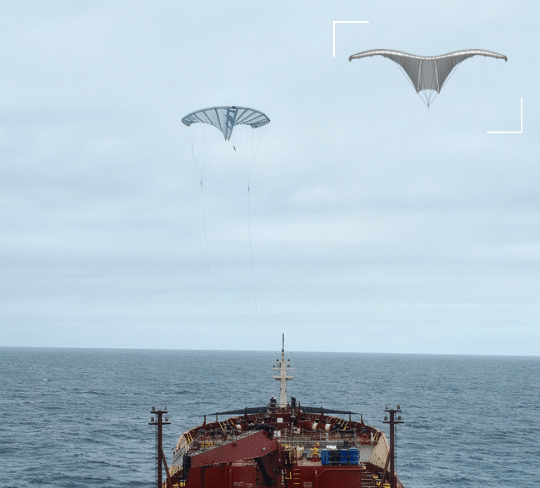
The kite generates very little power while remaining self-stable. This mode is used to launch and retrieve the wing safely.
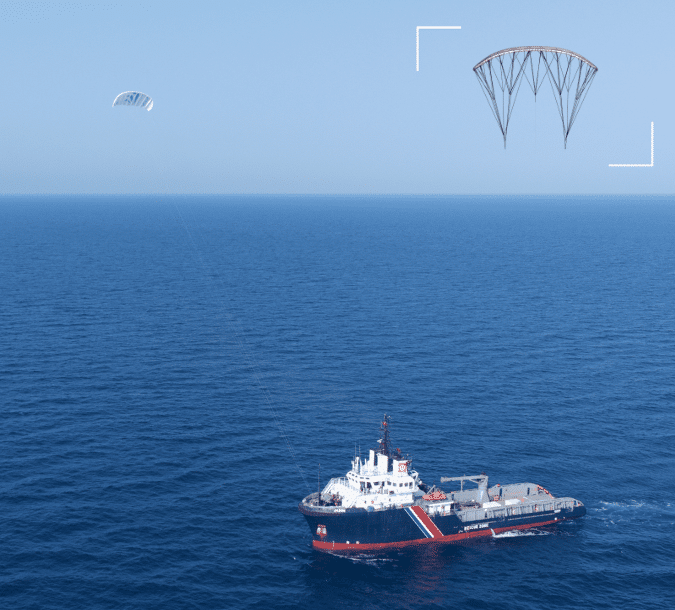
The kite is aligned with the wind, either at the masthead or at altitude, and generates no power.
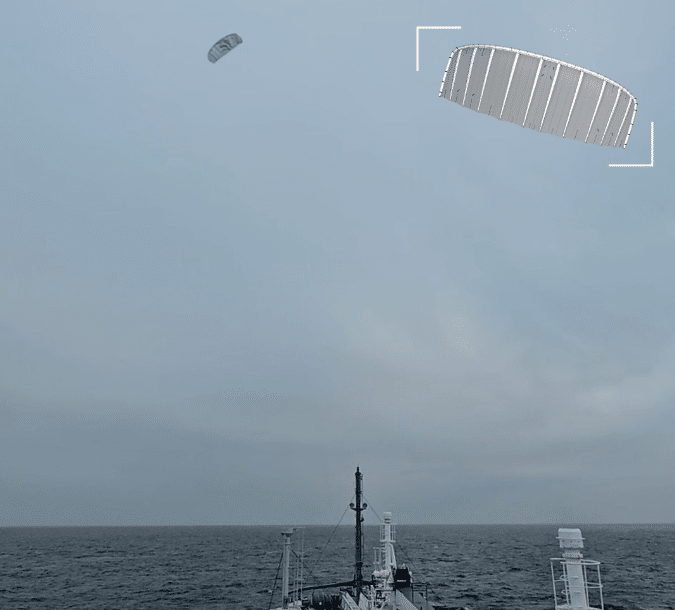
Static mode is ideal for optimising traction when sailing close-hauled. The autopilot holds the kite in a stable position at the edge of the wind window, generating optimised traction along the vessel’s direction of travel.
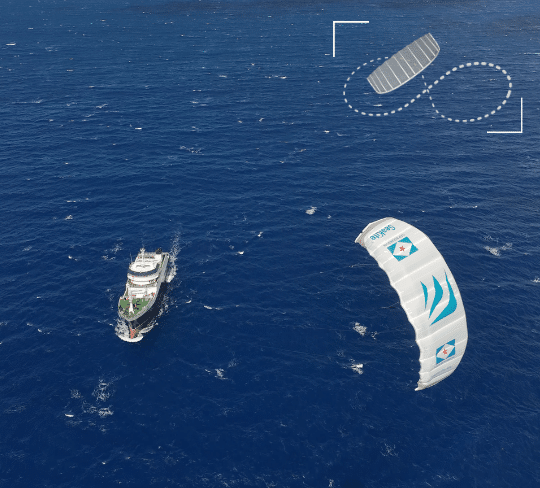
The kite flies figure-eight patterns within the wind window.
How do our solutions
generate traction?
The aerodynamic profile of our kite wings relies on a key physical principle. Air accelerates over the upper surface*, creating a low-pressure zone, and slows down beneath the lower surface**, creating a high-pressure zone. This pressure difference produces lift, the force that tows the vessel.
*upper surface: the top side of the wing
**lower surface: the underside of the wing

The onboard software we develop enables the control system to use the system’s sensor network to optimise wind power, while giving the operator an intuitive and safe user experience.
Product range and expected performance
SeaKite® is available in three power configurations, designed to suit vessels of different sizes and types:
- SeaKite® 300: capable of generating up to 5 tonnes of traction
- SeaKite® 600: capable of generating up to 10 tonnes of traction
- SeaKite® 2400: capable of generating up to 40 tonnes of traction